Refurbished Shipping Containers Are Only as Green as the Fit-Out Around Them
A 20-foot shipping container is about 2.2 tonnes of steel. A 40-foot one is closer to 3.7. Making that steel the conventional way, from iron ore in a blast furnace, releases roughly two tonnes of CO2 for every tonne produced. So a retired 20-footer holds something like four tonnes of carbon that has already been spent. Give the box a second job and you don’t spend it again.
That is the whole pitch for container buildings, and it holds up. It’s also the smallest part of the story.
RefurbishedContainers.com, a site of design concepts and planning guides for converted containers, makes the point against its own subject’s easy marketing in When Reusing a Container Is Not the Greener Choice. The reused shell is where the carbon account opens. What closes it is everything bolted, sprayed and wired onto that shell afterwards, plus every winter the finished room has to be heated.
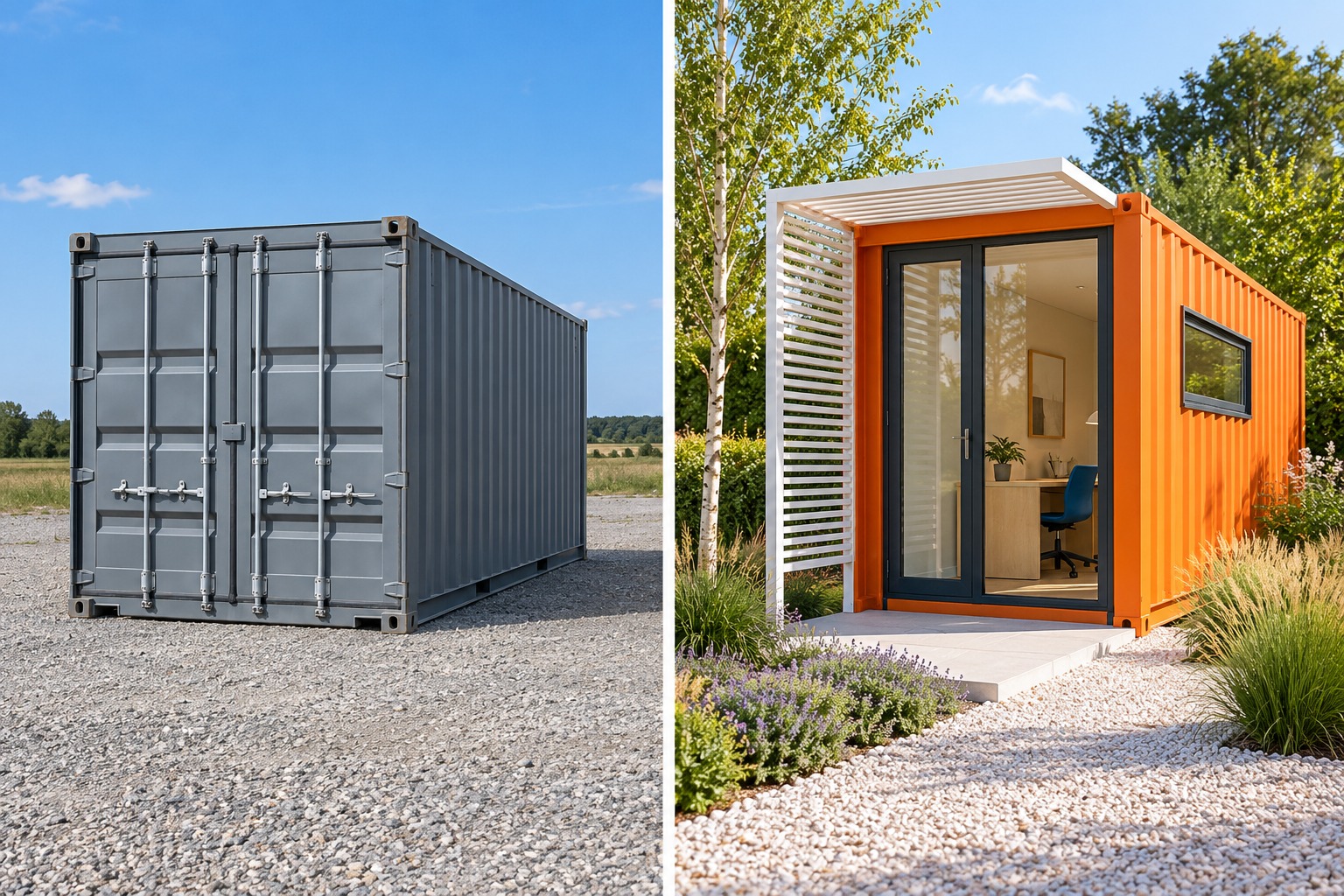
Image: pxef.com, AI-generated design concept.
Reuse and Recycling Are Different Claims
Old containers don’t pile up in landfill. Steel is one of the most recycled materials there is, and a scrapped box usually ends up melted in an electric arc furnace, which makes new steel for a fraction of the emissions of the blast furnace route. So “saved from the scrapheap” overstates the gain. The real comparison is between keeping the box as a structure and melting it down into something else.
Reuse still wins that comparison, provided the box keeps doing structural work. The corrugated side walls are what make a container stiff. Cut most of one out for a wall of glass and the frame needs new steel to compensate, which hands back part of the saving. A conversion with modest openings keeps far more of the original object than one that leaves a steel outline around a new building.
Then there’s the box’s history. A “one-trip” container, shipped once with cargo and sold off, is close to new steel made for a building in all but name. A worn unit at the end of its freight life is a better reuse candidate, if its floor and structure check out. Price alone won’t tell you which one you’re buying. The site’s guide to reading a container conversion quote beyond the shell price is a fair place to start asking.
The Fit-Out Decides the Number
Steel is a poor place to sit through a winter. It conducts heat quickly, and warm indoor air meeting a cold steel skin turns into water on the inside face, which is why condensation deserves a place in the design brief from day one. The usual answer is a thick layer of insulation, often spray foam. Some foams use blowing agents with a heavy warming effect of their own, so the product choice matters as much as the thickness.
Insulation also eats space. A container is narrow to begin with, and the finished width is the dimension that matters once walls are lined and services run. Too little insulation to save width, and the room leans on heating and cooling for the next twenty years. Over that time the energy a badly sealed office uses can outweigh the steel it saved.
Sun is the other side of it. A dark steel box in summer gets hot fast, and a big south-facing window makes it worse. Getting daylight without turning a container office into a greenhouse is mostly about shading and placement, and costs very little carbon if it’s planned early. Retrofitting air conditioning later costs a lot more.
Delivery belongs on the sheet too. A crane truck over a long distance is a real line item, and what the delivery truck needs before the container arrives affects both the bill and the emissions. It rarely decides the outcome on its own. It shouldn’t be left off.
Where a Refurbished Container Makes Sense
The strongest case is a box that stays mostly a box. Storage, a workshop, a farm stall. A utility container for a garden that actually gets used or a small farm shop in a reused container needs light insulation at most, keeps its walls whole, and runs on little energy. That’s reuse with almost nothing given back.
Container buildings also have a circular feature that most garden rooms lack. They can be lifted onto a truck and moved. A timber room on a concrete slab mostly can’t. That only counts if it’s designed in, with services that disconnect cleanly and a lining that can come out without destroying the shell.
The cheapest option for the climate is sometimes no new building at all. A spare room put back to work, along the lines of a home office refresh using the furniture you already own on HomePremise.com, beats any garden structure on carbon. Where a separate building is really needed, a refurbished container with modest openings, a good envelope and a long life ahead of it is a sound choice. Its green credentials come from the decisions made after the box is delivered, and the buyer should ask to see them.
The steel is the easy part.