FuelEU Maritime Makes Shore Power the Cheapest Compliance Lever for Big Container Ships
Every conversation about decarbonizing container shipping starts with the engine. Dual-fuel LNG or dual-fuel methanol, ammonia later, and a newbuild order that locks the answer in for twenty-five years. It’s the decision that gets the press release. For the compliance math a European carrier actually faces this decade, it isn’t the decision that moves the number most.
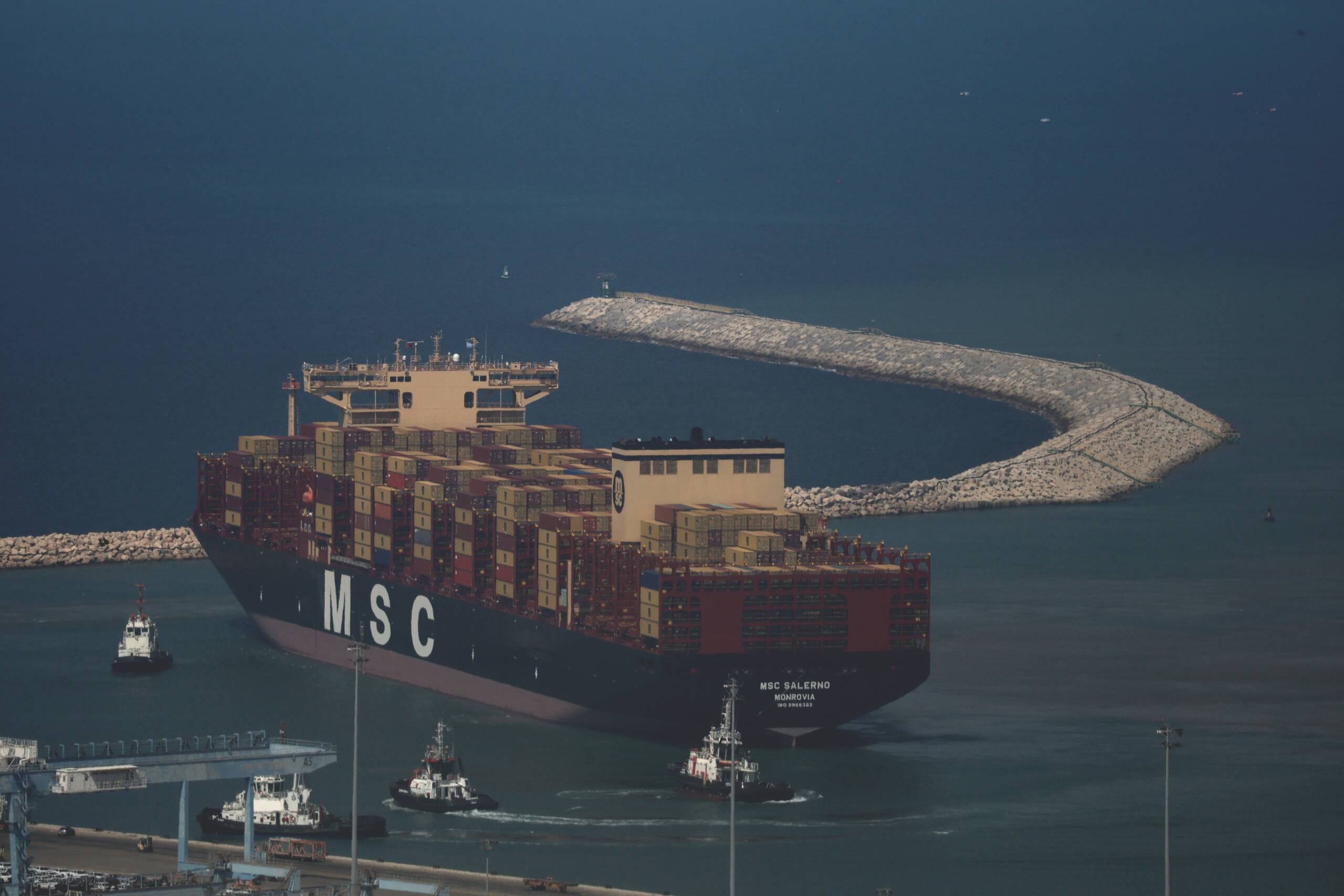
FuelEU Maritime has been in force since January 2025. It doesn’t regulate fuel choice directly. It sets a declining limit on the greenhouse gas intensity of the energy a ship uses, measured well-to-wake in grams of CO2 equivalent per megajoule, against a 2020 fleet baseline of 91.16. The required cut is 2% now, 6% from 2030, 14.5% from 2035, then 31%, 62% and 80% at five-year steps out to 2050. It covers any commercial vessel over 5,000 GT calling at an EU or EEA port regardless of flag, and it counts 100% of the energy used on intra-EU voyages and during port stays, 50% of energy on voyages in from or out to a third country.
Three things follow from that structure, and they’re worth separating.
Dual-fuel doesn’t clear the bar by as much as the brochure implies
LNG burned in a marine engine emits roughly a fifth less CO2 per unit of energy than fuel oil at the tailpipe. Well-to-wake accounting is less generous. Upstream extraction and liquefaction carry a cost, and unburned methane escaping through the combustion cycle carries a much larger one, because FuelEU counts methane and nitrous oxide alongside CO2. Low-pressure four-stroke and Otto-cycle engines slip more than high-pressure diesel-cycle designs, which is why the engine variant matters more than the fuel label.
The result is that a modern LNG dual-fuel ship comfortably clears a 2% requirement and starts looking uncomfortable well before the 31% step. Fossil methanol is worse, offering almost nothing on a well-to-wake basis. The green versions of both fuels genuinely solve the problem and are priced accordingly, with volumes that don’t yet exist at liner scale. Renewable fuels of non-biological origin get a reward multiplier under the regulation precisely because nobody expected uptake without one.
So the newbuild fuel decision buys a carrier headroom in the 2040s. It does not answer the question of what to do about the 2030 step, which arrives in three and a half years.
Berth energy is the part you can zero out
Here’s the asymmetry. A ship of this size sitting at a quay isn’t idle in energy terms. Auxiliary engines run the hotel load, the pumps, the lighting, the accommodation, and above all the reefer plugs, which on a heavily refrigerated trade are the dominant draw. Multiply a multi-megawatt load by a berth stay measured in days, then by four or five European calls per rotation, and port time accounts for a meaningful slice of the annual energy total that FuelEU divides into.
Electricity taken from shore is treated as zero for intensity purposes. Between 2025 and the end of 2029 that energy is zero-rated and drops out of the calculation entirely, which means every hour on the plug improves the ship’s annual average without anyone changing a drop of bunker fuel. From 1 January 2030 the incentive becomes an obligation: container and passenger ships above 5,000 GT moored at a TEN-T port must cover their full electrical demand from onshore power supply, with exemptions for calls under two hours, unscheduled arrivals, and ships already running zero-emission technology at berth. From 2035 the requirement extends to any EU port with an equipped quay.
Layer the EU Emissions Trading System on top and the case sharpens. Maritime is now at full phase-in, at-berth emissions are inside the scope, and methane and nitrous oxide joined CO2 in the scheme this year. Fuel burned alongside a quay is therefore hit twice, once through allowance cost and once through the intensity balance. Fuel not burned alongside a quay is hit neither way.
Cost per gram avoided, nothing else on the menu is close.
The bottleneck moved ashore
Which relocates the hard problem. A ship needs an OPS-ready notation, a high-voltage switchboard, a transformer and a cable handling arrangement, and that retrofit is a shipyard week and a manageable sum. A terminal needs a high-voltage connection sized in the range of several megavolt-amperes per berth, frequency conversion because ships run at 60 Hz and much of Europe runs at 50, a substation, and a grid connection that the local network operator can actually deliver. In Northern Europe those connection queues run years, and the port is competing for the same capacity against electric cranes, battery-electric terminal tractors and truck charging.
The Alternative Fuels Infrastructure Regulation obliges the relevant ports to have the equipment in place by 2030. Whether the electrons behind it show up on schedule is a grid planning question rather than a shipping question, and it’s the reason the FuelEU obligation includes an exemption for ports where the supply isn’t available.
One honest caveat. Shore power counts as zero under the regulation regardless of what generated it. Plug into a grid running on lignite and the accounting improvement is real while the atmospheric improvement is partial. The local air quality gain holds up either way, since burning marine fuel next to a city is a different problem from burning it mid-ocean, and European grid intensity keeps falling. But the regulatory zero and the physical zero are not the same number, and anyone modelling actual emissions rather than compliance balances should use the grid factor.
Globally the picture is still unsettled. The IMO’s Net-Zero Framework was postponed in October 2025 and adoption is now expected to be taken up again this autumn, with a global fuel standard and a pricing mechanism that broadly rhyme with the EU approach but contain no at-berth mandate. Until that lands, Europe’s rules are the operative ones for any ship in this trade.
The engine order decides what a ship can do in 2045. The shore connection decides what it costs to call at Rotterdam in 2031.