Europe Will Build More Wind Power but Grids Will Decide Its Future
Europe added 8.8 GW of wind power capacity in the first half of 2026, yet the latest industry outlook still puts the EU on course for roughly 342 GW by 2030, well below the 425 GW benchmark associated with its renewable energy ambitions. Growth is continuing. The harder question is how much of the next wave can be financed, connected and used when the electricity is available. Europe’s wind future will depend increasingly on decisions made beyond the turbine factory.
That distinction matters because a wind farm passes through several different realities before it supplies useful power. A government can award an auction, a developer can secure a permit and a manufacturer can announce an order while the project still lacks a workable connection date. Installed capacity measures the fleet’s maximum rated output; generation measures the electricity actually produced over time. Neither an auction announcement nor a capacity target should be mistaken for electricity delivered to a customer.
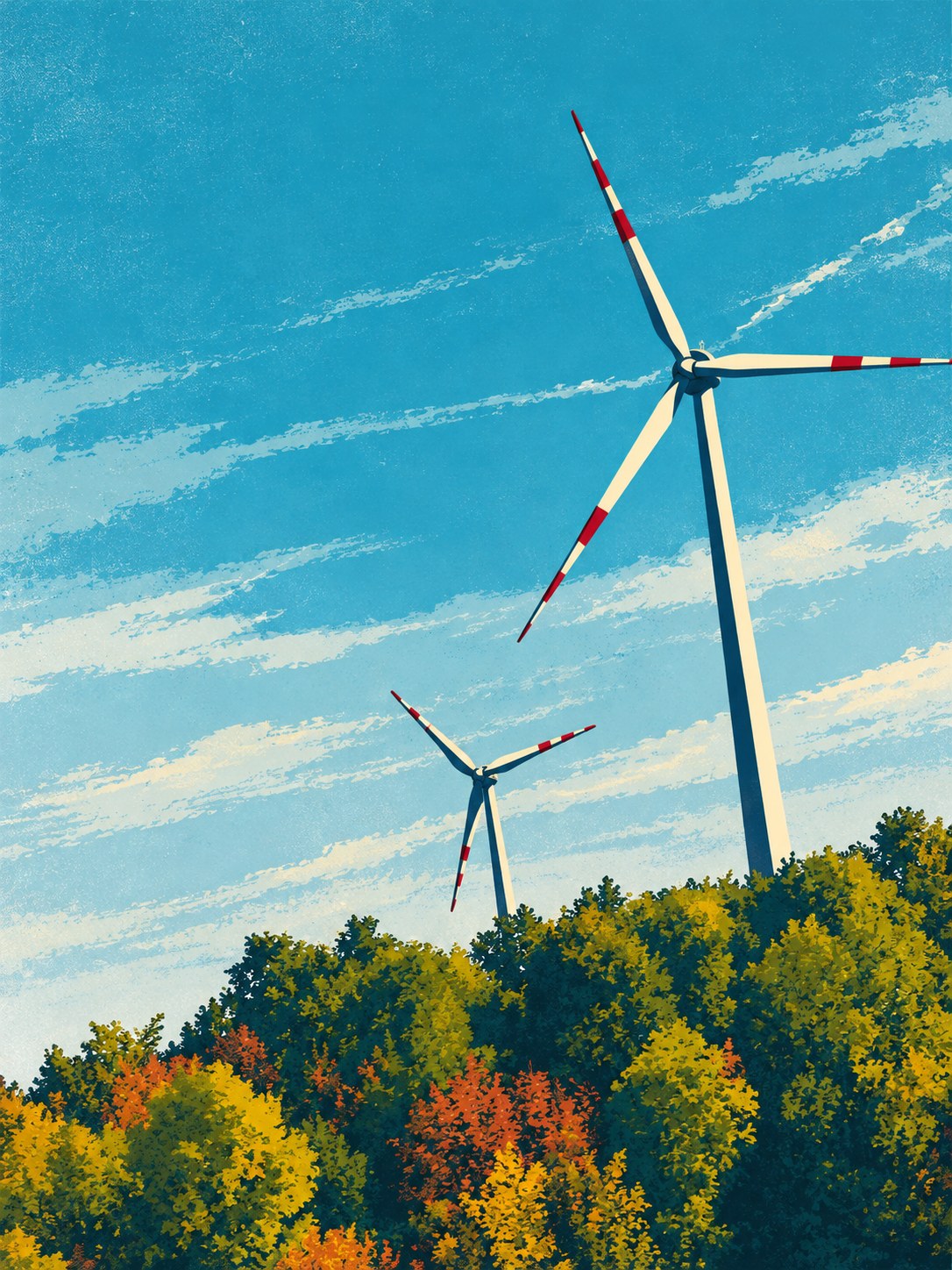
Image credit: Prints.org.
The accompanying poster gives that industrial story an unusually quiet setting. A large ivory turbine rises on the right, its narrow tower cut by a deep blue shadow and its three blades marked with sharp crimson bands. One blade stretches beyond the frame, making the structure feel larger than the picture can contain. A second, smaller turbine stands farther back above the trees. Across the lower part of the composition, dark teal woodland breaks into olive, mustard yellow and burnt orange, while pale streaks cross a broad turquoise sky. The grain of the print softens the hard geometry. It is an appealing image of energy production sharing a landscape, though making that relationship work on the ground takes rather more negotiation.
Onshore wind should remain central to the next phase. It represented 74% of Europe’s new wind capacity in the first half of 2026. Offshore projects attract attention because individual developments can be enormous, but the near-term expansion still rests heavily on turbines built on land. That makes local planning, access roads and community confidence central economic issues. A promising national target has limited value if individual projects spend years waiting for decisions.
Repowering deserves a larger place in that discussion. Replacing an aging fleet gives developers a chance to examine sites already used for wind generation, rather than treating every expansion as a search for untouched land. It is no automatic shortcut: larger machines can change visual impact, foundations and transport requirements, and a previous approval cannot answer every question about a different project. The useful test is the additional electricity a site can deliver after its environmental and network constraints have been assessed.
Offshore wind has a different financing problem. Construction at sea ties together expensive equipment, port capacity and tightly timed vessel work, with substantial spending before revenue begins. Interest costs and construction delays can therefore change the economics materially. An auction award establishes an opportunity; the final investment decision establishes that the developer has accepted the terms and risks. In October, the industry was still warning that substantial offshore volumes, particularly in Germany, risked failing to reach that investment stage. The pipeline needs to be judged at each step.
This argues for auction designs that produce buildable projects. Governments should assess whether contract terms can survive realistic construction costs and whether the grid will be ready when the wind farm is ready. Repeatedly awarding capacity that cannot reach construction creates a misleading impression of progress. Equally, shifting unlimited risk to electricity customers would weaken the case for expansion. Contracts need clear responsibilities, credible delivery dates and competition that reaches beyond a headline bid price.
Grid expansion is the central link between these projects and their customers. A coastal wind farm and an inland factory may be separated by several constrained sections of network. Adding generation on one side does not remove those constraints. Transmission investment, stronger connections between countries and more effective use of existing equipment can increase the value of the fleet already built. Europe’s wider transition outlook increasingly treats system integration as the task that sets the pace.
Storage helps, provided its limits are kept visible. Batteries can respond quickly, support grid operation and shift electricity into hours when demand is higher. Their usefulness depends on both power, measured in MW, and stored energy, measured in MWh. A battery able to discharge at high power for a few hours cannot sustain that output through several windless days. Longer shortages call for a system-wide combination of available generation, suitable storage and demand response. Cross-border trade helps too, although neighbouring countries can experience similar weather.
Demand deserves as much attention as supply. Factories able to adjust some processes, heat systems with thermal storage and vehicles charged at flexible times can make better use of variable generation. The commercial question is whether customers have an incentive to move consumption and whether their connection allows it. Electrification also needs to make financial sense for a business replacing a gas-fired process. A growing wind fleet without corresponding network access and usable demand can face more curtailment and weaker revenues.
Public acceptance remains part of delivery. The poster’s forest should not be read as evidence that any wooded site is appropriate for turbines. Protected habitats, birds and bats require site-specific assessment, and access infrastructure can matter as much as the towers. Earlier surveys and meaningful local participation can expose problems while designs can still change. Community benefits may improve the bargain, but they do not substitute for environmental assessment.
The outlook to 2030 therefore supports continued expansion with substantial execution risk. WindEurope’s autumn projection puts total European capacity at about 436 GW by the end of the decade, including roughly 342 GW in the EU. These are forecasts, not completed assets. The stronger path would pair project approvals with financed construction and timely connections, then judge success through usable electricity and customer costs. That would also reduce exposure to imported fuel prices, while leaving Europe responsible for the equipment, maintenance and balancing its own power system needs.
Europe has ample reason to keep building wind. The next phase will be decided by whether its electricity system can turn that construction into dependable economic value. The turbines are the visible part. A connection that arrives on time may matter just as much.