Why Trump Hates Wind Energy
Donald Trump’s hostility toward wind energy has become too persistent to explain as a disagreement over the price of electricity. He objects to the appearance of turbines, attacks their reliability and subsidies, and has used presidential power to restrict their development. His record supports an explanation that combines a personal property dispute, an energy agenda centered on fossil fuels, and the political usefulness of treating wind as a symbol of everything he dislikes about climate policy. Nobody outside his own head can assign a precise weight to each motive. What we can examine is where the hostility appeared, how he expresses it, and what his administration does with it.
The photograph accompanying this article offers a quieter version of the argument. A white turbine rises from dense scrub, its three blades outlined against a clear blue sky. Beside it, a broad umbrella-shaped pine spreads a dark canopy above tangled branches; the foreground mixes silvery leaves, deep greens and patches of rusty brown. The machine’s straight tower and long blades interrupt an otherwise organic landscape. Some viewers will find that contrast graceful. Others will see an industrial object intruding on a view. The photograph illustrates that visual tension.
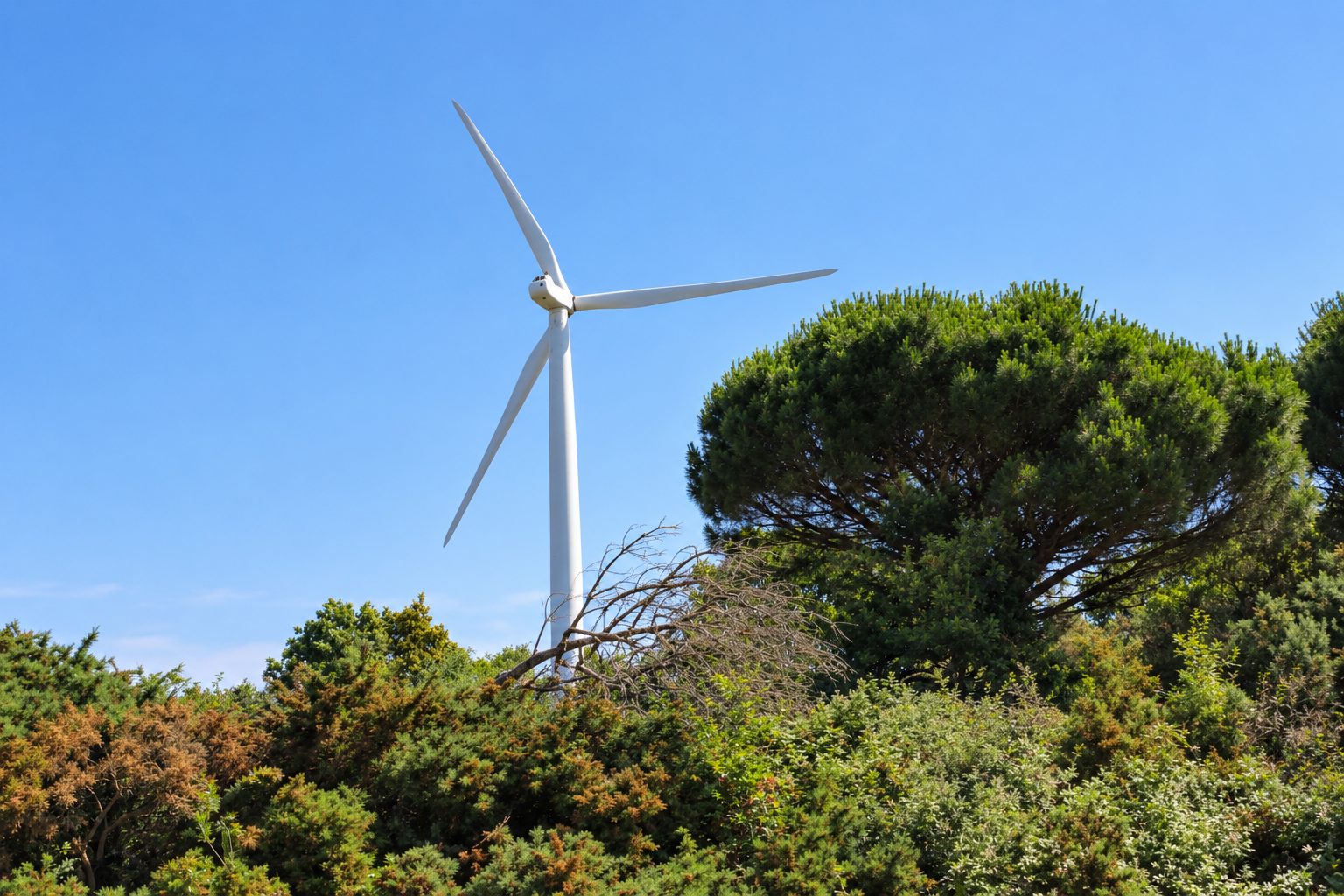
Image hosted by Pxef.com.
For Trump, the visual objection has a documented commercial history. His golf resort at Menie, near Aberdeen, opposed the European Offshore Wind Deployment Centre in Aberdeen Bay. The UK Supreme Court’s December 2015 judgment records that the proposed turbines would be visible from the resort, about 3.5 kilometres away, and that the golf company feared a loss of amenity. His companies challenged the Scottish consent and lost their Supreme Court appeal. This was a dispute involving the surroundings of a business he owned, years before the current American fight over offshore wind. It gives the personal explanation firmer ground than casual speculation about his temperament.
It would still be a stretch to claim that a lost Scottish lawsuit explains every subsequent energy decision. The more useful interpretation is that an existing dislike acquired political allies and a much larger stage. A turbine could represent an unwelcome development near his property and, later, the renewable-energy agenda of his opponents. Those associations reinforce each other. When an object already annoys you, discovering that your political rivals celebrate it is unlikely to improve your opinion. That is an interpretation of his public record, of course, rather than a claim to know his private thinking.
His preference for fossil fuels provides the policy framework. Trump has repeatedly paired attacks on wind with calls to expand oil and gas production, including his January 2025 demand that Britain reopen North Sea opportunities and remove wind farms. Oil, gas and coal fit his account of national wealth as something extracted, produced and sold. Wind belongs to a different story about power generation and avoided fuel consumption. There is also a basic distinction worth keeping in view: wind mainly competes in electricity markets, particularly with other generators, rather than directly replacing every use of petroleum. Political speeches tend to flatten those separate markets into a single contest.
Wind also makes a convenient political target because its costs and inconveniences are visible. Turbines are large. Transmission lines cross property. Coastal communities can object to views, fishing disruption and construction traffic. Developers may seek public support while negotiating with utilities over expensive projects. A politician can gather those grievances into a simple accusation that an elite is imposing an unwanted energy system. The benefits can be less visible to an individual observer: electricity delivered elsewhere, fuel purchases avoided, emissions reduced, or payments supporting a local landowner. My reading is that this imbalance helps explain the appeal of the rhetoric. A turbine is easier to put in a campaign image than a counterfactual fuel bill.
Some objections deserve serious examination. Wind output changes with weather, and a power system needs enough flexibility to serve demand through those changes. Transmission, storage, demand response and other generation all have roles, with costs that depend on the system. A low generation cost at one windy site does not establish the full cost of supplying customers every hour. Nor does variable output establish that wind cannot contribute useful electricity. The Department of Energy describes grid balancing as a continuing task across interconnected sources, while the International Energy Agency’s 2026 electricity report emphasizes the growing need for flexibility as wind and solar expand. Both points belong in an honest assessment.
Environmental claims need the same discipline. Poorly located turbines can harm birds and bats, while offshore construction and vessels create risks that require mitigation. Those concerns justify surveys, siting decisions and enforceable protections. They do not validate every alarming claim made against the industry. NOAA Fisheries says there are no known links between large whale deaths and ongoing offshore wind activities, and no scientific evidence that noise from site-characterization surveys causes whale deaths. That finding leaves room for continued monitoring and risk reduction. It does not support treating an asserted connection as an established cause.
The distinction between scrutiny and categorical hostility becomes clearest in government action. Trump’s January 20, 2025 memorandum withdrew offshore areas from new wind leasing and directed a pause in new federal wind approvals pending review. Its leasing withdrawal explicitly exempted other purposes, including oil and gas. That was a choice among technologies, rather than a general retreat from energy development. The precise legal position has since been contested, so the original memorandum should not be read as a complete description of every project’s status today. It does, however, show how directly his preference entered federal decision-making.
The campaign continued into October 2026. Reporting on October 21 described administration requests to reconsider approvals for New England Wind, Revolution Wind and Maryland Offshore Wind. Those are requests within ongoing proceedings, not proof that every permit has been revoked or every project cancelled. Their commercial significance is nevertheless clear: reopening approvals introduces uncertainty after developers and suppliers have already made commitments. Even a project that ultimately prevails can lose time and incur additional costs. A government seeking abundant electricity should account for the cost of its own interventions when it criticizes a technology’s economics.
There are sound reasons to reject particular wind projects. A weak resource, unsuitable site, excessive cost or unacceptable ecological impact can each defeat the case for development. Trump’s opposition goes much further than that project-by-project test. The most convincing explanation is the alignment of his longstanding visual dislike, his fossil-fuel agenda and the value of wind as a political adversary. Each makes the others easier to sustain. The consequence is a policy debate in which the turbine’s symbolic meaning can crowd out the practical question: would this project, in this place and on these terms, improve the electricity system? That is the question consumers actually need answered, even when the view from a golf course says otherwise.