Water Recycling Can Cut Freshwater Demand but the Energy Balance Matters
Water recycling gives a town or factory another use for water it has already collected. Treated wastewater can supply irrigation, industrial processes and, with the appropriate treatment and oversight, drinking water. Each use can reduce demand for fresh supplies. The energy case needs a separate calculation: a recycling system consumes electricity, and its value depends partly on what source of water it replaces and how far the water must travel.
The photograph captures the physical side of that calculation. Four tall assemblies stand across a busy exhibition floor, their transparent vertical sections held between deep blue flanges and thick rings of bolts. Rounded blue valve bodies sit below them, connected to grey pipework that runs horizontally across the foreground before bending upward at the right. Smaller brass fittings, pressure gauges and black control cables crowd the spaces between the larger components. Behind the equipment, visitors wearing badges talk beside white display plinths on blue carpeting; a strip of artificial grass runs along the front of the stand. It is a dense, slightly awkward view of infrastructure, with pipes cutting across people and other exhibits. The photograph shows water handling equipment rather than a complete recycling plant, and it cannot establish any particular treatment performance. Still, it makes a useful point: keeping water in circulation takes hardware, controls and people who know how to maintain them.
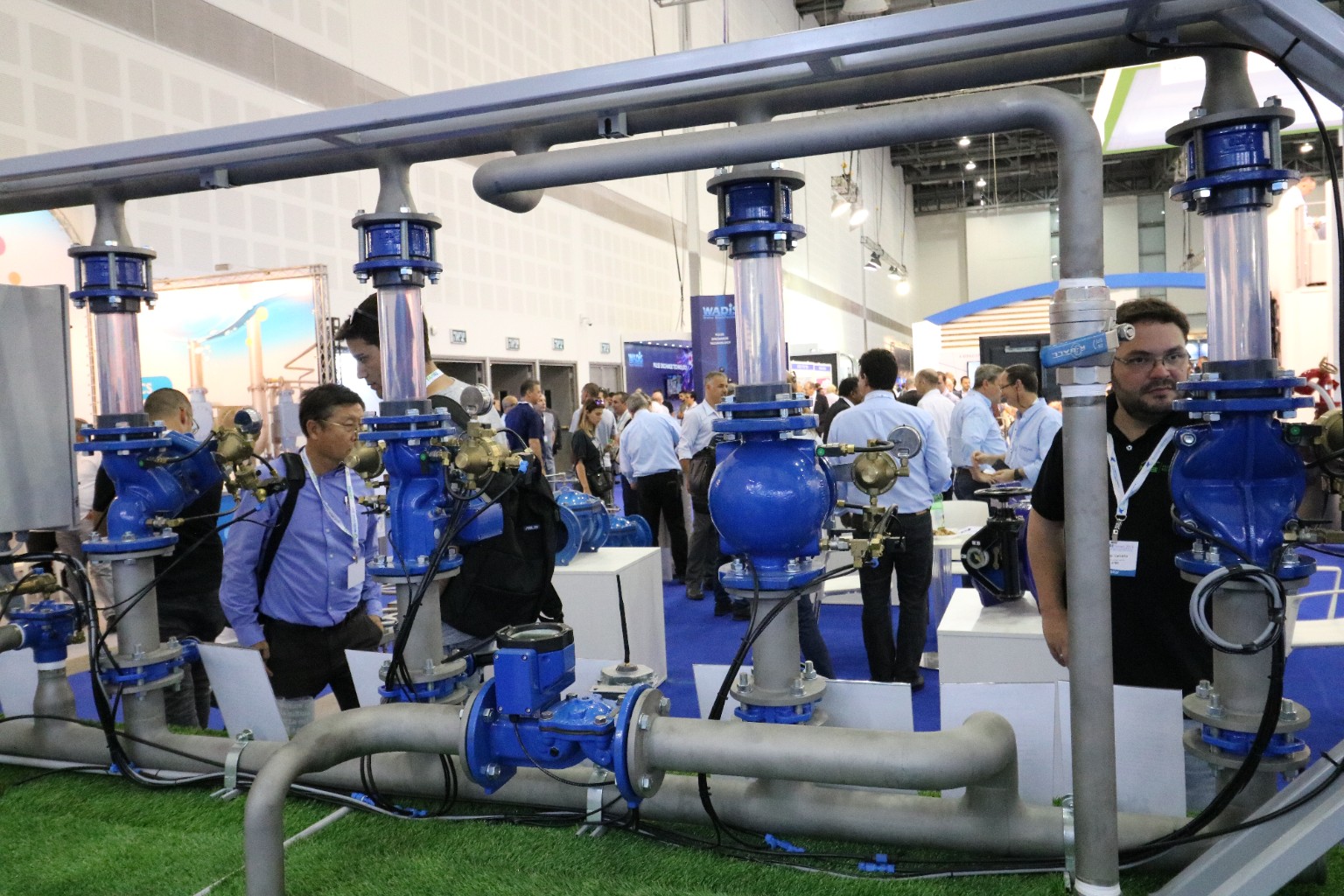
Image credit: EventCalendar.net.
A recycling project starts with the quality of the incoming water and the requirements of the next customer. Municipal wastewater, relatively lightly contaminated greywater and industrial effluent present different problems. Water suitable for one factory process may be unsuitable for another. The sensible design treats water to a defined standard for a defined use, with monitoring that can show the standard is being met. A label saying “recycled” tells a buyer very little about either.
For many projects, the immediate opportunity is a non-drinking use. Irrigation and toilet flushing can displace demand on drinking water systems, provided the reclaimed supply meets the relevant requirements. Industrial cooling is another possible application, although salts and other constituents can affect equipment operation and treatment needs. Keeping separate water supplies safely separated is part of the engineering. So is making sure that a customer has enough dependable demand to justify the new pipes.
Drinking water reuse needs a more demanding treatment and assurance system. Depending on the design, successive barriers can include filtration, membranes and disinfection, with several processes addressing overlapping hazards. Indirect potable reuse passes through an environmental buffer such as an aquifer or reservoir; direct potable reuse proceeds without that buffer. Neither description, by itself, answers whether a particular project is safe. That rests on the approved design, operating performance and oversight. The transparency of the exhibition pipes is visually appealing, but clear-looking water provides no evidence that dissolved contaminants or pathogens have been adequately controlled.
The energy balance begins beyond the treatment plant fence. A local reuse scheme may avoid the electricity needed to lift imported water over hills or move it across a region. Advanced treatment adds its own load. A published study of US potable reuse facilities estimated advanced treatment electricity use ranging from 0.23 to 2.5 kilowatt-hours per cubic meter, excluding conveyance to the advanced treatment facility and pumping for supply augmentation. That wide range is a warning against treating “water recycling” as one machine with one efficiency figure. The boundary of the calculation matters as much as the number.
Distance can undo an attractive treatment result. A nearby industrial customer with steady demand may offer a better starting point than a scattered group of seasonal users needing a long distribution network. Elevation matters too. Project comparisons should include the full route from collection to delivery and the energy used by the displaced supply. A lower electricity bill at one plant is not sufficient evidence of a lower-energy water system. Carbon emissions then depend on the electricity supplying that system, so energy savings and emissions savings should be calculated separately.
There are residuals to manage as well. Some treatment processes produce sludge, while membrane systems can generate a concentrated reject stream. Recycling does not make those materials disappear. Cleaning, replacement parts and staff time continue throughout the plant’s life, and those costs belong in the price of delivered water. The valves in the photograph are a useful reminder here: equipment needs to be isolated for service, faults need to be found, and a process must remain controllable when individual components are unavailable.
Smaller systems can bring reuse closer to demand. Collecting and treating water within a building or district can reduce the need to transport it elsewhere, but it also creates a local operating responsibility. Someone must manage maintenance and respond when water quality falls outside its permitted range. Municipal systems spread that work across a larger service area; smaller installations need an equally credible arrangement at their own scale. Buying equipment is the beginning of that obligation.
The strongest case for water recycling is specific: a known source, a customer who can use the output, and a measured reduction in freshwater demand at an acceptable operating cost. Conservation and leak repairs remain useful alongside it. For a project seeking both water security and lower emissions, the decisive evidence is how much suitable water reaches its customer and what it takes to deliver it year after year. The trade show stand makes the hardware visible. The long-term result depends on what happens after the exhibition closes.